Core Gameplay Loop
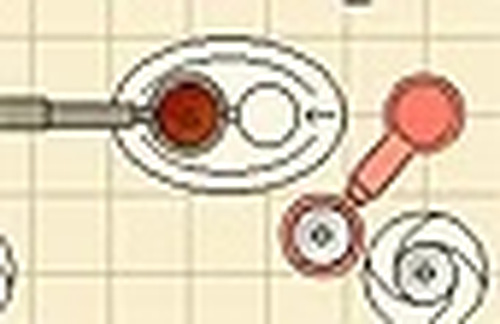
At its heart, Glyph Logic Assembly is about constructing a sequence of actions. Players place mechanical arms onto a grid to pull basic elements from small circular generators. These raw elements are then moved to glyph stations, which alter their properties or combine them into new substances. The final product must be delivered to a large target circle at the top of the screen. The number inside that target indicates how many times the correct combination must be successfully deposited to clear the level.
Strategic Planning Over Speed
There is no timer or pressure to act quickly. The challenge lies in analyzing the required output and working backward to determine which elements are needed, what glyphs will transform them, and how to arrange the arms efficiently. Players can take as long as they like to experiment with different setups, making it a thoughtful exercise in logistics and deduction.
Visual Clarity and Minimalist Design
The interface uses a clean, uncluttered look with simple geometric shapes. Each element and glyph is clearly distinguished by color and symbol, so players can quickly identify what is on the grid. This minimalist approach helps maintain focus on the puzzle itself rather than on navigating complex menus or deciphering busy graphics.
Progressive Difficulty Through New Combinations
Early levels introduce the basic mechanics with simple one-step transformations. Later stages require multi-step processes, where an element must be transformed multiple times or combined with several others before it matches the target. This gradual increase in complexity keeps the game accessible for newcomers while still offering a satisfying challenge for experienced puzzle enthusiasts.
Experimentation as a Core Tool
Because there is no penalty for trying a configuration that does not work, players are encouraged to test different arrangements. Trying a glyph on an unexpected element might reveal a useful transformation. This open-ended trial-and-error approach means that solving a level often comes from exploring possibilities rather than following a single correct path.